
Agriculture is the backbone of India’s economy, supporting millions of farmers and contributing significantly to the country’s food security. However, after harvesting crops, large quantities of agricultural residue, including straw, stalks, and other plant materials, remain in the fields. Managing this residue efficiently is an important challenge, particularly when farmers have limited time to prepare their fields for the next cropping season.
One common practice is stubble burning, in which leftover crop residue is set on fire to clear agricultural land quickly. Although this method may appear convenient, it releases smoke and pollutants into the atmosphere and contributes to environmental concerns.
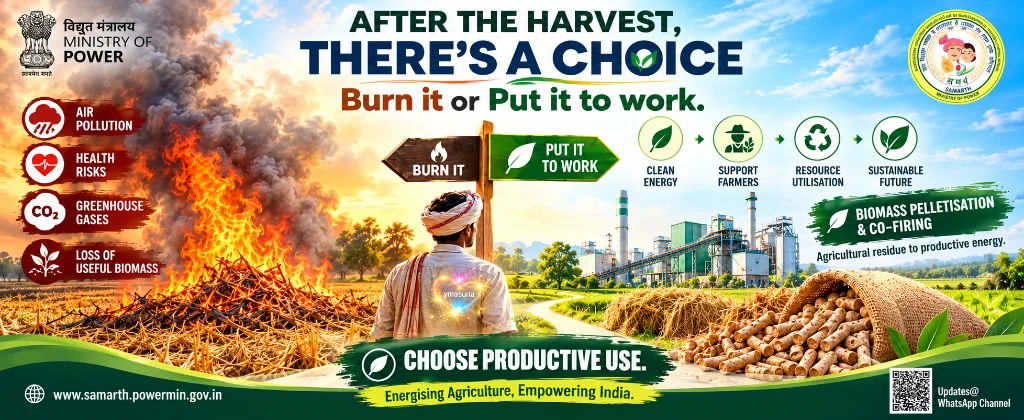
The good news is that agricultural residue does not always have to be treated as waste. As highlighted in the poster by the Ministry of Power, Government of India, under the SAMARTH initiative, suitable crop residue can be converted into biomass pellets and used productively for energy generation.
The message is simple and powerful:
“After the harvest, there’s a choice: Burn it or put it to work.”
After harvesting crops such as paddy, farmers may be left with substantial quantities of straw and other residue. When this material is burned in open fields, the fire releases smoke, particulate matter, and other pollutants.
The consequences can include:
Farmers often face practical challenges, including short intervals between crops, labour shortages, machinery costs, and the expense of removing residue. Therefore, reducing stubble burning requires realistic and affordable alternatives rather than simply asking farmers to stop.
One productive alternative is biomass pelletisation.
Biomass pelletisation is the process of converting suitable agricultural residue into small, compact cylindrical pieces called biomass pellets. Depending on the feedstock and process, the raw material is collected, prepared, dried when necessary, and compressed into a more manageable form.
The main stages generally include:
The poster illustrates this transformation by contrasting a field where residue is being burned with a productive industrial facility and a pile of biomass pellets.
The objective is to convert agricultural leftovers into a useful fuel resource, provided the material is suitable and the process is economically viable.
Another important concept highlighted in the poster is biomass co-firing.
Co-firing means using biomass fuel alongside a conventional fuel, such as coal, in a suitable power-generation system. Biomass pellets can provide a more standardised form of agricultural residue that is easier to handle than loose straw.
Potential benefits include:
However, the actual environmental benefit depends on several factors, including the type of biomass, how it is collected and processed, transportation distances, combustion technology, and the fuel it replaces. Co-firing also requires appropriate plant infrastructure, fuel-quality standards, and compliance with applicable regulations.
Biomass is therefore not a universal solution for every type of crop residue, but it can be an important option where suitable facilities and supply chains exist.
Agricultural residue management should not be viewed only as an environmental responsibility. It can also create opportunities for rural communities when suitable markets and infrastructure are available.
Possible benefits for farmers and rural areas include:
These benefits are not automatic. Farmers need access to reliable buyers, fair prices, affordable machinery, practical logistics, and transparent purchasing arrangements. The economics will vary by crop, location, residue quantity, and transportation costs.
A successful system should therefore benefit farmers while also meeting the needs of biomass processors and energy producers.
The visual elements in the Ministry of Power poster communicate four connected ideas:
🌿 Environmental protection: The green leaf represents the productive and responsible use of agricultural resources.
⚡ Energy generation: The electricity symbol represents the potential to use biomass as an energy resource.
👨🌾 Farmer empowerment: The farmer symbol highlights the importance of agricultural communities in making residue utilisation successful.
♻️ Resource recycling: The circular arrows represent the idea of using resources more efficiently instead of wasting them through open burning.
Together, these symbols explain the central message: agricultural residue can become part of a more sustainable system when it is collected, processed, and used appropriately.

The poster identifies the Ministry of Power, Government of India, and the SAMARTH initiative. SAMARTH is associated with promoting biomass utilisation, including biomass co-firing in thermal power plants.
The initiative reflects the importance of developing a productive link between agricultural residue and the energy sector. Such efforts depend on cooperation among farmers, biomass aggregators, pellet manufacturers, transportation providers, power plants, and relevant government agencies.
For more information, readers can visit the website printed on the poster:
Official website: https://samarth.powermin.gov.in/
The poster also displays a QR code for the SAMARTH WhatsApp Channel, which readers can scan directly from the original image to explore the channel and available updates.

Reducing open-field burning requires practical action from several stakeholders.
Other residue-management options may also be appropriate, depending on local agricultural conditions. These include mulching, incorporation into soil where suitable, composting, and other approved uses. The best solution depends on the crop, soil, machinery, local climate, and available infrastructure.
Agricultural residue is not necessarily waste. With suitable technology, responsible planning, and an effective supply chain, it can become a valuable resource for energy production and rural economic activity.
Moving away from open-field burning is not just about reducing smoke. It is about finding practical ways to connect agriculture, environmental protection, and energy needs.
The message from the poster is worth remembering:
“Choose Productive Use.”
Instead of allowing valuable crop residue to disappear in flames, India can continue exploring ways to turn suitable agricultural waste into useful resources.
Energising Agriculture, Empowering India.
This article is intended for general informational and educational purposes. It is based on the key messages and visual information presented in the supplied poster, supplemented with general explanations of agricultural residue management, biomass pelletisation, and biomass co-firing. It is not an official government publication, policy notification, or endorsement by the Ministry of Power or the SAMARTH initiative. The benefits and feasibility of biomass utilisation depend on local conditions, technology, costs, fuel quality, and applicable regulations. Readers should consult relevant official sources and qualified experts before making operational, financial, or agricultural decisions.


📞 Contact Us for Biomass Solutions
📍 Servoday Plants & Equipments Ltd
📞 +91 9427210483 | +91 9427210484
📧 [email protected]
🌐 www.PelletIndia.com
👤 Contact Person: Sanjay Masuria
📲 WhatsApp: +91 9427210483
From Concept to Commissioning. We are with You.
Our policy is simple and transparent:
No undersized parts, no fraud, no fake components—genuinely serving since 1969. 🚀🔥